🎧 Listen to this article
You already know cortisol is your stress hormone. What you might not know is that cortisol and inflammation are locked in a feedback loop — and when that loop breaks, it doesn’t just affect your mood. It disrupts your sleep, your energy, your ability to recover from workouts, and how fast you age. If you’re waking up at 3am with your mind racing, this loop is probably why.
We’ve covered why inflammation specifically wakes you at 3am and how the cortisol curve itself shifts under inflammatory load. What we haven’t unpacked is the bidirectional mechanism — how cortisol and inflammation actively make each other worse, creating a cycle that tightens on itself every day it goes unaddressed.
How the loop actually works
Under normal conditions, cortisol is anti-inflammatory. That’s one of its primary jobs. When your body faces a threat — physical injury, infection, acute stress — cortisol rises and tells your immune system to dial down the inflammatory response once the threat has passed. It’s the built-in off switch.
The problem starts when the stress doesn’t pass. When cortisol stays elevated for days, weeks, or months, your immune cells stop listening to the signal. This is called glucocorticoid resistance — your inflammatory receptors downregulate, and cortisol loses its ability to suppress inflammation. A 2002 review in the Journal of Clinical Endocrinology and Metabolism documented how chronic HPA axis activation leads to exactly this kind of receptor desensitization.
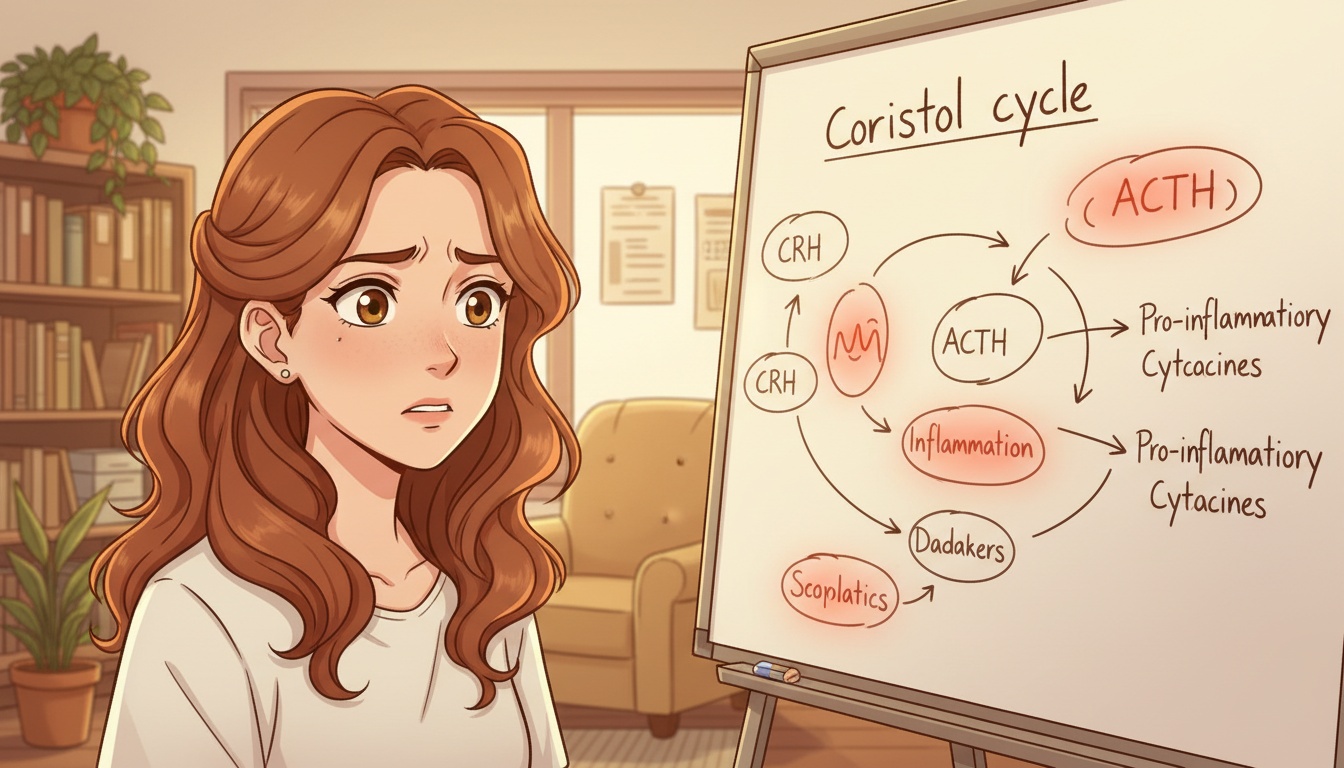
Here’s where the loop tightens: once cortisol can’t suppress inflammation anymore, inflammatory cytokines — particularly IL-6 and TNF-alpha — rise unchecked. And these cytokines don’t just sit there. They feed back into the HPA axis, stimulating more CRH release from the hypothalamus, which drives more ACTH, which produces more cortisol. Your body keeps pumping out cortisol to fight inflammation that cortisol can no longer control.
A 2005 study in Neuroimmunomodulation showed that IL-6 directly modulates cortisol secretion through this HPA axis feedback. Under healthy conditions, IL-6 peaks around 7am, contributing to the cortisol awakening response. In people with chronic inflammation, that peak shifts to 3–4am — which is exactly when you bolt upright, mind racing, unable to fall back asleep.
Why this hits differently after 40
If you’re a woman in perimenopause or menopause, this loop has extra fuel. Declining estrogen affects both cortisol metabolism and inflammatory signaling. Estrogen normally helps regulate the HPA axis sensitivity — as it drops, your stress response becomes more reactive. The same stressor that wouldn’t have woken you up at 35 now jolts you awake at 45.
Layer on the inflammation that comes with hormonal shifts — joint stiffness, gut changes, disrupted sleep architecture — and you’ve got a cortisol-inflammation feedback loop with no natural off switch. This is why cortisol becomes the aging hormone nobody tests for. It’s not just stress. It’s a structural change in how your body handles the stress-inflammation relationship.
The 3am wake-up as a diagnostic signal
That 3am cortisol spike isn’t random. It’s a predictable consequence of the feedback loop. When IL-6 peaks shift earlier due to chronic inflammation, your cortisol awakening response fires hours before it should. You don’t gently wake — you’re suddenly fully alert, often with a racing heart or anxious thoughts.
The cruel irony: the sleep disruption from these wake-ups produces more IL-6, which amplifies the cortisol curve the next night. A 2016 study in Chronobiology International showed that even short sleep duration increases IL-6 production, creating a self-reinforcing cycle. One bad night makes the next night worse. Three bad nights in a row and the loop is established.
Breaking the cycle — what actually works
The goal isn’t to suppress cortisol. Cortisol is essential — you need it to function. The goal is to restore the feedback loop so cortisol can do its job of regulating inflammation again.
1. Test what your doctor isn’t testing. A single morning cortisol draw tells you almost nothing. Ask for hs-CRP (high-sensitivity C-reactive protein) as a proxy for systemic inflammation, and if possible, a DUTCH test or salivary cortisol curve that maps your cortisol across 24 hours. If hs-CRP is above 1.0 mg/L, the loop is likely active.
2. Address the gut — it’s driving the inflammation. Your gut microbiome is the largest source of systemic IL-6 in most people. Gut dysbiosis produces bacterial endotoxins (LPS) that enter circulation and keep inflammatory cytokines elevated. A targeted probiotic — like Garden of Life Mood+ with L. helveticus and B. longum strains — helps modulate gut-driven inflammation. We covered gut-brain axis mental health for the full mechanism.
3. Supplement magnesium to support HPA axis regulation. Magnesium glycinate — like this one from Organics Ocean — doesn’t suppress cortisol. It helps your body regulate the curve more accurately, which means the 3am spike doesn’t cross the waking threshold as easily.
4. Add omega-3s to dampen the inflammatory signal at the source. Omega-3 fatty acids directly reduce IL-6 and TNF-alpha production. Nordic Naturals Ultimate Omega is a high-potency option that targets the inflammatory driver feeding the loop.
5. Use L-theanine to smooth the overnight cortisol curve. L-Theanine 200mg taken before bed modulates the cortisol response without sedation. It doesn’t block cortisol — it raises the threshold so the 3am rise doesn’t trigger conscious waking.
6. Time your last meal. Eating within 3 hours of bed increases overnight IL-6 levels. An early dinner with protein and fiber, minimal refined carbohydrates, gives your gut time to settle before the inflammatory amplification window opens.
What we still don’t know
The cortisol-inflammation loop is well-documented in mechanism, but the exact tipping point — how much chronic stress, sustained for how long, before glucocorticoid resistance becomes clinically significant — hasn’t been mapped. We know the loop exists. We know it self-reinforces. What we don’t yet know is the precise threshold where a normal stress response becomes a permanent feedback cycle.
What we do know: if you’re waking at 3am, the loop is probably already running. And the longer it runs, the harder it gets to break — not because you can’t, but because each night of disrupted sleep makes the next night worse. The first step is recognizing that your 3am alarm isn’t a sleep problem. It’s an inflammation problem wearing a cortisol mask.
If someone you know is stuck in this cycle, this might explain why.