🎧 Listen to this article
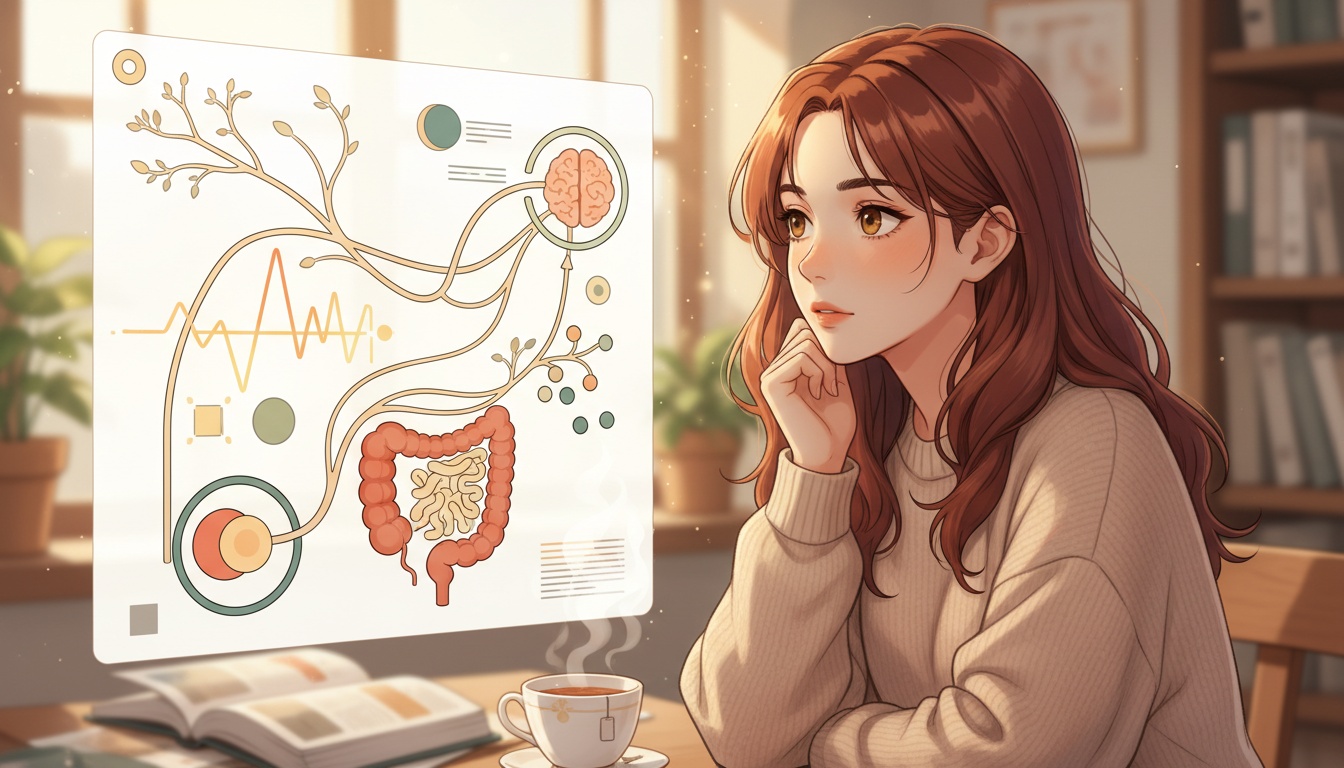
You’ve probably heard that serotonin is a brain chemical. That’s technically true — but it’s about 5% of the story. The other 95% of your body’s serotonin is produced in your gut, by specialized cells that respond directly to what your gut bacteria are doing. When people talk about the gut-brain connection, this is the mechanism they’re usually pointing at. And it’s more concrete than most wellness articles make it sound.
If you’ve been following our coverage of the gut-brain microbiome mental health connection, you know the communication highway exists. This post is about the specific cargo traveling on it — and why your gut’s serotonin production has more influence over your mood than anything happening in your head.
What’s actually happening
The mechanism starts with tryptophan, an essential amino acid you get from food. In your gut, enterochromaffin cells — specialized serotonin-producing cells scattered throughout your intestinal lining — convert tryptophan into serotonin using an enzyme called tryptophan hydroxylase 1 (TPH1). This gut-derived serotonin doesn’t cross the blood-brain barrier directly. Instead, it operates through an indirect pathway that’s even more interesting.
Your gut bacteria don’t just passively coexist with this system — they actively regulate it. Specific microbial species influence how much tryptophan gets converted to serotonin versus being shunted down the kynurenine pathway, which produces neurotoxic metabolites instead. A 2023 review in Nutrients detailed how certain gut bacteria — particularly Clostridium species and spore-formers — directly stimulate enterochromaffin cells to increase serotonin production (Shin et al., Nutrients, 2023 — https://pubmed.ncbi.nlm.nih.gov/37892541/).
When your gut microbiome is balanced, tryptophan flows primarily toward serotonin production. When it’s disrupted — by antibiotics, chronic stress, processed food, or inflammation — the kynurenine pathway steals the tryptophan precursor. The result: less serotonin available for the vagus nerve signals that regulate mood, sleep, and emotional resilience.
This is the same cortisol-inflammation feedback loop we covered in the 3am wake-up post — stress drives cortisol, cortisol disrupts gut bacteria, disrupted bacteria shift tryptophan away from serotonin, and lower serotonin makes you more reactive to stress. It’s a circuit, and your gut is running it.
Why this happens to you specifically
If you’re a woman in your 30s or 40s, hormonal shifts are already perturbing your gut microbiome. Estrogen and progesterone influence gut motility, permeability, and microbial composition. As these hormones fluctuate — particularly during the luteal phase, perimenopause, or times of high stress — the gut environment changes in ways that favor the kynurenine pathway over serotonin production.
This explains something many women experience but can’t articulate: the mood changes that seem to come from nowhere. Not a reaction to a stressful event, not a psychological trigger — just a sudden shift toward irritability, anxiety, or flatness. When you understand that your gut is producing the majority of your serotonin, and that hormonal shifts are altering which bacteria are dominant, the “mystery mood changes” stop being mysterious.
It also explains why SSRIs — which work by keeping serotonin active longer in the brain — have inconsistent results. If gut serotonin production is already suppressed because tryptophan is being diverted, you’re recycling a diminished supply rather than addressing the upstream problem.
What you can do today
1. Feed the tryptophan-serotonin pathway. Tryptophan-rich foods include turkey, eggs, salmon, pumpkin seeds, and tofu. But raw tryptophan availability isn’t the bottleneck — the conversion is. Your gut bacteria determine how that tryptophan gets used.
2. Support the microbial species that drive serotonin production. Clostridium species (the non-pathogenic strains) and certain Lactobacillus species are key regulators. Fermented foods — sauerkraut, kimchi, yogurt, kefir — introduce these species or support their growth.
3. Reduce kynurenine pathway competition. Chronic inflammation and cortisol both push tryptophan toward kynurenine rather than serotonin. Anti-inflammatory dietary patterns — omega-3 fats, polyphenol-rich berries, turmeric — help restore the balance. Our coverage of walnuts and brain food explains the polyphenol mechanism in detail.
4. Protect your gut barrier. Intestinal permeability (“leaky gut”) allows bacterial endotoxins into the bloodstream, which triggers systemic inflammation that steals tryptophan. Bone broth, colostrum, and L-glutamine support barrier integrity.
5. Time your meals. Serotonin production follows a circadian rhythm. Eating at consistent times supports the regularity of enterochromaffin cell function. Erratic eating patterns — skipping meals, late-night eating — disrupt the rhythm.
What to stop doing
Ignoring gut symptoms and treating mood changes as purely psychological. If you’re dealing with bloating, irregular bowel habits, or food sensitivities alongside mood shifts, the gut is likely driving both. Treating only the mood with supplements or medications while ignoring the digestive symptoms is treating the downstream signal while leaving the upstream source untouched.
Also: taking high-dose tryptophan supplements without addressing gut health first. If your microbiome is shifting tryptophan toward kynurenine, adding more tryptophan just feeds a broken pathway. The gut environment needs to change before the precursor loading matters.
The supplement question
Garden of Life Probiotics Mood+ — Formulated specifically for mood support with Lactobacillus helveticus and Bifidobacterium longum, strains studied for their effects on the gut-brain axis.
Nordic Naturals Ultimate Omega — High-potency EPA/DHA supports anti-inflammatory pathways that protect tryptophan from kynurenine diversion.
Life Extension Neuro-Mag Magnesium L-Threonate — The brain-bioavailable form of magnesium. Supports serotonin receptor function and sleep architecture.
What we still don’t know
The exact microbial composition that optimizes serotonin production in any given person is still undefined. We know which species are involved — Clostridium, certain Lactobacillus strains, enterochromaffin cell stimulators — but the specific ratios, the minimum effective diversity, and how individual genetics interact with microbiome composition to determine serotonin output remain open questions.
There’s also a timing gap in the research. Most studies show associations between microbiome states and serotonin markers, but the interventional trials that would prove “change X bacterial species and Y amount of serotonin increases” in humans are still sparse. The mechanism is established. The clinical protocol for optimizing it in a specific person is not.
What you can act on now: your gut bacteria are producing most of your serotonin, and what you feed them determines how well that system works. The science will get more precise. The foundational principle won’t change.
Share this with someone who’s been told their mood issues are “just in their head.”