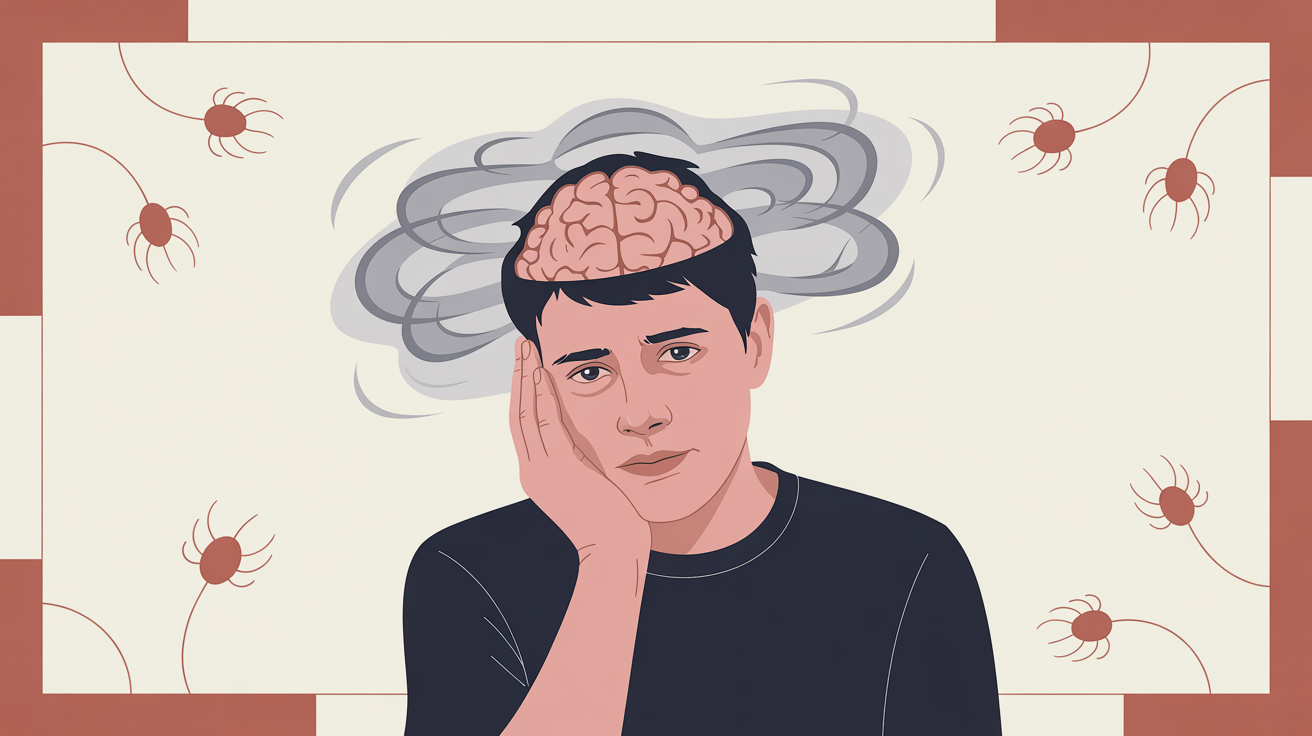
Why you can’t think straight after 40
You used to walk into a room and know why you were there. Now you stand in the doorway, staring at the wall, trying to remember if you came for your phone, your keys, or something you can’t name at all.
It’s not dementia. It’s not laziness. It’s not “just getting older.”
Your hormones are shifting, and your brain is feeling it.
The brain-hormone connection nobody explains
Your brain runs on hormones the way your car runs on fuel. When the fuel mix changes, the engine doesn’t stop — it just runs differently. Rougher. Slower.
After 40, three major hormonal shifts start hitting your cognitive function:
1. Estrogen decline (yes, men too)
Estrogen isn’t just a “female hormone.” It’s a neuroprotective hormone that maintains memory, focus, and verbal fluency. Both men and women have it — men just have less.
After 40, estrogen starts its decline. For women, it’s the perimenopause cliff. For men, it’s a gradual drop that most don’t notice until the symptoms pile up.
Research published in Menopause (Maki et al., 2024) found that “brain fog” is one of the most common cognitive complaints during perimenopause — affecting up to 60% of women. But here’s the thing: men experience it too. They just call it “stress.” (PubMed)
What estrogen does for your brain:
- Maintains acetylcholine levels (the memory neurotransmitter)
- Supports hippocampal function (where memories form)
- Regulates serotonin and dopamine (mood and motivation)
- Protects against neuroinflammation
When estrogen drops, all of these take a hit.
2. Testosterone decline (the quiet one)
Testosterone isn’t just about muscle and libido. It’s directly involved in cognitive processing speed, spatial memory, and executive function.
A study in Annals of the New York Academy of Sciences (Moffat, 2005) showed that men with higher testosterone levels performed better on cognitive tests, and that testosterone replacement improved memory and processing speed in older men. (PubMed)
Women need testosterone too. When it drops — which it does after 40 — both sexes experience:
- Slower thinking
- Reduced mental stamina
- Difficulty with complex problem-solving
- That “foggy” feeling
3. Thyroid slowdown (the sneaky one)
Your thyroid controls your metabolism — including your brain’s metabolism. When thyroid function dips (even within “normal” lab ranges), your brain slows down.
This is why your blood work can say “everything’s fine” while you’re sitting there wondering why you can’t concentrate on a paragraph.
What brain fog actually feels like
It’s not dramatic. It’s subtle. And that’s what makes it so frustrating:
- You forget words mid-sentence
- You reread the same paragraph three times
- You can’t hold multiple thoughts at once
- You feel mentally “heavy” — like thinking through mud
- Your reaction time gets slower
- You lose your train of thought more easily
Sound familiar? You’re not losing your mind. Your hormonal environment is changing, and your brain is adapting.
The three things that actually help
1. Get your hormones tested — properly
Standard blood work often misses hormonal shifts. Ask for:
- Estradiol (not just “estrogen” — the specific form)
- Free testosterone (not just total — free is what’s actually available)
- TSH, Free T3, Free T4 (full thyroid panel, not just TSH)
- Cortisol (morning, fasting)
Don’t accept “it’s in the normal range” as an answer. “Normal” for a 25-year-old and “normal” for a 45-year-old are different things.
2. Protect your sleep like it’s medicine
Sleep is when your brain clears metabolic waste and consolidates memory. When hormones disrupt sleep (and they do — especially cortisol and progesterone), your brain can’t do its maintenance work.
A study in World Journal of Psychiatry (Borozan et al., 2024) confirmed that hormone-related sleep disruption directly impacts next-day cognitive function. (PubMed)
What to do:
- No screens 1 hour before bed (blue light suppresses melatonin)
- Keep your room cool (65-68°F / 18-20°C)
- Magnesium glycinate before bed (supports GABA production)
- Same wake time every day (regulates cortisol rhythm)
3. Feed your brain what it needs
Your brain is 60% fat. It needs:
- Omega-3 fatty acids (EPA and DHA — from fish or algae)
- B vitamins (especially B12 and folate — support methylation)
- Vitamin D (most people over 40 are deficient)
- Magnesium (involved in 300+ enzymatic reactions, including neurotransmitter synthesis)
Don’t guess. Get tested. Supplement what you’re actually low in.
The bottom line
Your brain isn’t broken after 40. It’s running on a different fuel mix. The fog isn’t permanent — but it won’t clear on its own.
Get your hormones tested. Protect your sleep. Feed your brain.
The thinking straight part? That comes back when the chemistry is right.
Related reading:
- Why intermittent fasting crashes your hormones — if you’re fasting and foggy, this explains why
- Your gut bacteria are running your hormones (coming May 9) — the gut-brain connection is real
- Omega-3s: the one supplement that actually does something (coming May 8) — what your brain is starving for
Research cited:
- Maki PM et al., Menopause (2024) — Menopause and brain fog: how to counsel and treat midlife women
- Maki PM et al., Climacteric (2022) — Brain fog in menopause: a health-care professional’s guide for decision-making and counseling on cognition
- Moffat SD, Ann N Y Acad Sci (2005) — Effects of testosterone on cognitive and brain aging
- Borozan S et al., World J Psychiatry (2024) — Hormone replacement therapy for menopausal mood swings and sleep quality
- Zhu C et al., Menopause (2026) — Factors associated with subjective cognitive symptoms during the menopause transition
Support your brain and hormones:
- Nordic Naturals Ultimate Omega — EPA/DHA for brain health and inflammation
- Magnesium L-Threonate — Neuro-Mag (Life Extension) — crosses the blood-brain barrier, supports cognitive function and memory
- Phosphatidyl Serine 100mg (NOW Foods) — lowers cortisol response, supports memory and brain function
- L-Theanine 200mg — calm focus without sedation, cortisol and anxiety support
This post contains affiliate links. If you purchase through these links, I may earn a small commission at no extra cost to you.