🎧 Listen to this article
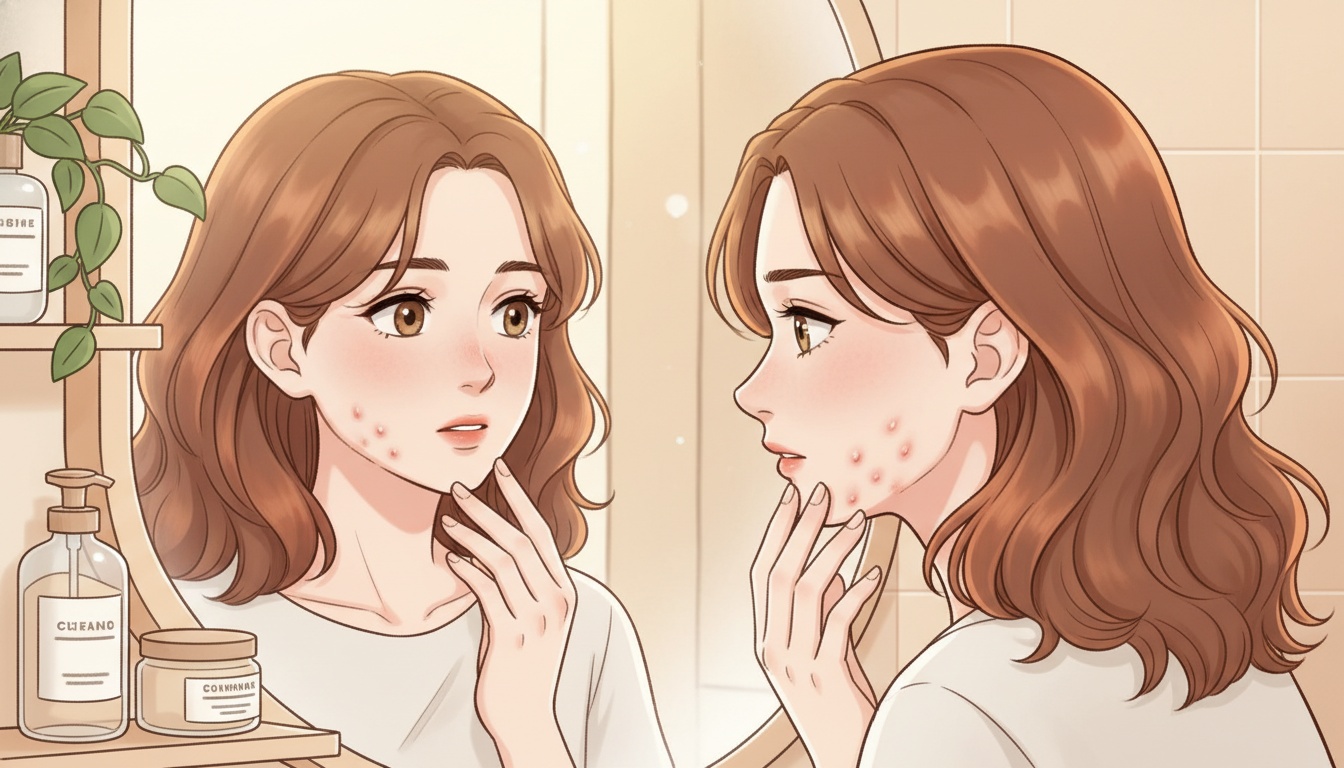
You used a 2% benzoyl peroxide for ten years and it worked. You’re using it now and it isn’t. The ingredient didn’t change. The skin underneath it did. If you’re dealing with breakouts along your jaw and chin in your late 30s or 40s — the kind that showed up out of nowhere and won’t respond to what used to work — you’re not doing anything wrong. You’re treating the wrong condition.
What’s actually happening
Teenage acne and adult hormonal acne look similar in the mirror. Underneath, they’re driven by different mechanisms.
In your teens, acne is primarily seborrhea-dominant — your sebaceous glands are in overdrive from pubertal androgen surges, producing excess oil that clogs pores. That’s why benzoyl peroxide and salicylic acid worked. They addressed the surface oil and bacteria.
Adult hormonal acne is different. The mechanism involves three overlapping systems:
Androgen sensitivity at the sebaceous follicle. Your absolute androgen levels may be normal, but your skin’s receptor sensitivity has increased. The follicle overreacts to normal amounts of testosterone and DHEA. This concentrates breakouts along the jaw, chin, and lower face — areas with the highest density of androgen-sensitive sebaceous glands: Hazarika N, J Dermatolog Treat (2021) — https://pubmed.ncbi.nlm.nih.gov/31393195/.
Insulin’s amplifying effect. Insulin suppresses sex hormone-binding globulin (SHBG), which normally keeps free testosterone in check. When SHBG drops, more free testosterone is available to bind to skin receptors. Even mild insulin resistance — the kind that develops gradually in your 30s and 40s — can tip this balance: Thiboutot D, Clin Dermatol (2004) — https://pubmed.ncbi.nlm.nih.gov/15556729/.
Inflammatory background load. Chronic low-grade inflammation — from stress, poor sleep, gut dysbiosis — primes the immune system to overreact to normal skin bacteria. The result is deeper, more painful lesions that take longer to heal.
The combined effect: your skin is more sensitive to androgens, those androgens are amplified by insulin, and the inflammatory response makes everything worse. Benzoyl peroxide can’t touch any of that.
Why this is happening to you specifically
If you’re in your late 30s or 40s, several converging factors are working against your skin.
The perimenopausal androgen-to-estrogen ratio shift. As estrogen begins its erratic decline in perimenopause, androgens become proportionally more dominant. Your ovaries and adrenal glands continue producing DHEA and testosterone, but there’s less estrogen to balance them. This is why estrogen dominance changes show up in your face first.
Stress converts to androgens. Cortisol is synthesized from the same precursor (pregnenolone) as DHEA. Under chronic stress, your body prioritizes cortisol production, but the downstream metabolic pathways can increase androgen activity. This is why breakouts flare during high-stress periods even when your skincare routine hasn’t changed.
Insulin resistance as amplifier. Even without a PCOS diagnosis, many women in their 40s develop mild insulin resistance. This isn’t about weight — it’s about how cells respond to insulin over time. The insulin-SHBG-androgen cascade is one of the most well-documented links in adult female acne: Bagatin E et al., An Bras Dermatol (2019) — https://pubmed.ncbi.nlm.nih.gov/30726466/.
Discontinued hormonal birth control. If you stopped birth control in your 30s or 40s, the androgen rebound can be dramatic. The pill was suppressing your androgen activity; without it, your baseline sensitivity is exposed.
What you can do today
1. Reframe your routine — gentleness wins now. Over-stripping made teenage acne worse and makes 40s acne significantly worse. Your skin barrier is thinner and more compromised than it was at 20. Stripping it further increases inflammation and transepidermal water loss, which triggers more oil production as compensation. Switch to a gentle, non-foaming cleanser.
2. Use ingredients with adult-skin evidence.
- Azelaic acid (15–20%): Anti-inflammatory, reduces androgen-driven keratinization, safe for long-term use. This is the workhorse for adult hormonal acne.
- Niacinamide (5%): Reduces sebum production, improves barrier function, anti-inflammatory. Works synergistically with azelaic acid.
- Tretinoin (0.025–0.05%): Increases cell turnover, prevents microcomedone formation. Different mechanism in adult skin than teenage skin — it’s addressing slowed turnover, not excess oil.
- Salicylic acid (low concentration, 0.5–1%): Useful as a targeted treatment, not a daily cleanser.
3. Address the systemic levers. Blood sugar regulation matters more than any topical. Reducing refined carbohydrates, eating protein and fat with meals, and walking after eating can improve insulin sensitivity within weeks. Sleep and stress management aren’t optional — they directly affect the cortisol-androgen-inflammatory axis. If your cortisol is running high, your skin will show it.
4. Think mechanism-first ordering. Don’t layer products hoping something works. Identify the upstream variable — is it androgen sensitivity? Insulin? Inflammation? — and target that first. Surface-level treatment without addressing the driver is why nothing sticks.
What to stop doing
Stop layering twelve actives. More products = more barrier disruption = more inflammation. Three well-chosen actives outperform a bathroom counter full of serums.
Stop following teenage-acne advice from skincare creators. The 22-year-old influencer with oily skin and comedonal acne is solving a different problem than you are. Their routine will make yours worse.
Stop spironolactone-shopping on Reddit. Spironolactone is a legitimate treatment for adult female acne — a 2024 randomized controlled trial confirmed its efficacy compared to doxycycline (Dréno B et al., Acta Derm Venereol (2024) — https://pubmed.ncbi.nlm.nih.gov/38380975/) — but it’s a prescription medication with real side effects. This is a doctor conversation, not a blog conversation.
The supplement / product question
Zinc — Evidence supports modest improvement in inflammatory acne at 30–50mg daily. Mechanism: anti-inflammatory, reduces sebum production, supports immune regulation. Take with food to avoid nausea.
Berberine — If you have insulin resistance or PCOS-adjacent symptoms, berberine addresses the insulin-SHBG-androgen link directly. Studies show it can improve insulin sensitivity comparably to metformin in some populations.
DIM (diindolylmethane) — Supports estrogen metabolism and may help rebalance the androgen-to-estrogen ratio. Evidence is thinner than zinc or berberine, but the mechanism is plausible for perimenopausal women.
Nordic Naturals Ultimate Omega — https://amzn.to/4ugtZVN — Omega-3s reduce inflammatory load, which is one of the three drivers of adult hormonal acne. Not a cure, but it lowers the background inflammation that makes everything else worse.
Vital Proteins Collagen Peptides — https://amzn.to/3QTeIvP — Collagen supports skin barrier repair. If your barrier is compromised from years of over-treating, this helps rebuild the foundation that actives work on top of.
What we still don’t know
Whether gut–skin axis interventions — specific probiotic strains, prebiotic fiber types — reliably move adult hormonal acne, or whether the effect is mediated entirely through inflammation reduction. The strain-level data is genuinely thin. Some dermatologists are recommending specific probiotic strains for acne, but the evidence doesn’t yet support strain-specific recommendations. The mechanism is plausible; the clinical proof isn’t there yet.
Save for later — send to someone who’s tired of being told to “just wash your face more.”