🎧 Listen to this article
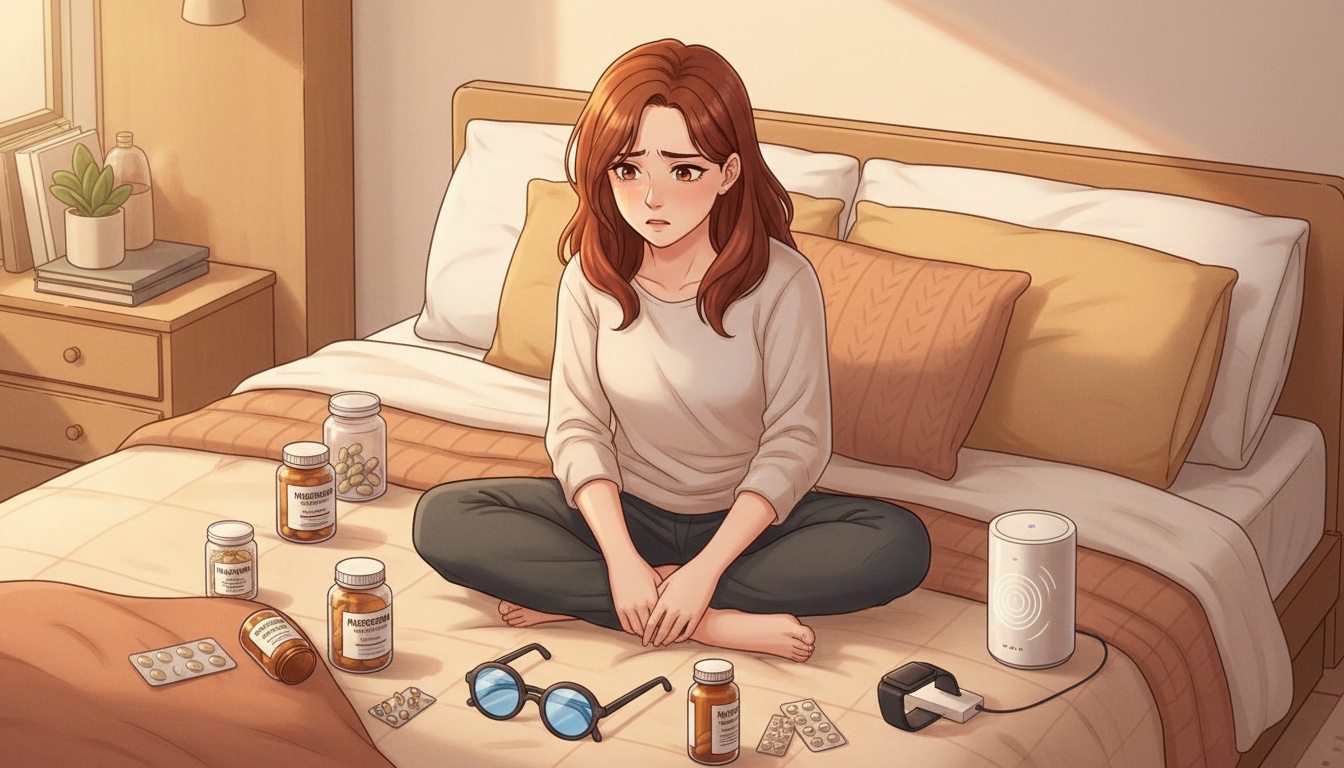
You have a sleep routine. Magnesium at 8pm. Blue-light glasses on at 9. Lavender spray on the pillow. Blackout curtains drawn. White noise machine calibrated to brown noise because you read it was better. You fall asleep by 10:15 and wake at 6:15 feeling… not great. Not terrible. But not the deep, effortless rest you were promised. So you add ashwagandha. Then glycine. Then a new mattress topper. And somewhere in the middle of all this optimization, a quiet thought creeps in: Why isn’t this working? That thought — that specific worry — is the reason it’s not working.
A 2010 review found that people with chronic insomnia have measurably elevated cortisol, higher metabolic rates, and increased sympathetic nervous system activity; their bodies run hotter even when they’re lying still in the dark (Riemann et al., Sleep Med Rev, 2010). The mechanism behind it was mapped in 2002 by Allison Harvey: worry about sleep triggers physiological arousal, which makes sleep harder, which generates more worry. The loop sustains itself without any external stressor (Harvey, Behav Res Ther, 2002).
What’s actually happening in your body when you try to sleep?
The routine you built to fix your sleep has become the worry trigger. Every supplement you add, every protocol you follow, every morning you check your Oura score is another signal to your brain that sleep is a problem to be solved. And your brain responds to problems the only way it knows how: by alerting your stress system.
Sleep medicine has a name for this relationship between effort and insomnia, and it doesn’t get enough attention. The effort itself is the problem. The more deliberately you try to fall asleep, the more awake you become. The Glasgow Sleep Effort Scale, a validated clinical tool, specifically measures how hard a person is trying to sleep, because that effort is one of the strongest predictors of insomnia severity (Doos Ali Vand et al., Nat Sci Sleep, 2020).
How does the cortisol feedback loop work step by step?
Cortisol follows a daily rhythm: high in the morning, low at night. That rhythm is what lets you feel sleepy when it gets dark and alert when the sun comes up, and anything that disrupts it disrupts sleep.
A 2019 study found something striking. Anticipating stress the next day, without experiencing it, measurably increased cortisol the following morning (Kramer et al., Psychoneuroendocrinology, 2019). Your brain doesn’t distinguish between anticipating a work deadline and anticipating a bad night’s sleep. Both trigger the same cortisol response.
So here’s the loop, step by step:
Step 1: You go to bed with a plan. Supplements taken, room temperature set, sleep tracker on. The plan itself creates a low-grade performance pressure.
Step 2: You lie there and notice you’re not falling asleep. Normally this wouldn’t matter; you’d drift off eventually. But tonight, you have a protocol. The protocol says you should be asleep by now.
Step 3: Cortisol rises. Not dramatically — you don’t feel stressed in the way you’d recognize. But your body is now in a state of monitoring, checking, evaluating. Your HPA axis is active when it should be dormant.
Step 4: You fall asleep eventually, but the sleep is lighter and more fragmented. Your tracker tells you this in the morning with a disappointing REM number.
Step 5: You see the number and feel validated: something is wrong. You research more protocols. Add more supplements. The optimization intensifies.
Step 6: That night, the cortisol starts earlier.
That’s the feedback loop: a self-reinforcing system where the attempt to fix the problem becomes the thing maintaining it. Morin and colleagues described chronic insomnia as exactly this kind of self-perpetuating cycle in The Lancet, noting that the behavioral and cognitive responses to poor sleep are often more damaging than whatever triggered the original sleep disruption (Morin et al., Lancet, 2012).
Why are health-conscious people more vulnerable to sleep optimization stress?
If you’re the kind of person reading this post — health-conscious, disciplined, probably tracking multiple biomarkers — you’re at higher risk than average. There’s nothing wrong with you. The same traits that make you good at optimizing your health make you terrible at letting go of sleep.
You solve problems by researching, measuring, and adjusting. That works for nutrition. It works for fitness. It does not work for sleep, because sleep is the one biological process that actively resists conscious effort.
The more sophisticated your approach, the more opportunities you create for anxiety. Magnesium glycinate vs. L-threonate. Brown noise vs. pink noise. 67°F vs. 65°F. Each decision point is a place where your brain can ask: Did I choose wrong?
What can you do today to break the cycle?
Audit your sleep routine for anxiety triggers. Not every supplement or habit is a problem. But if your routine has more than 4-5 components, some of them are creating more stress than they’re relieving. Strip it down. Keep what clearly helps. Drop what you added from worry.
Stop checking your sleep score. This is uncomfortable advice for someone who spent $300 on a wearable. But the data is feeding the loop, not helping you. If you can’t delete the app entirely, check it once a week instead of every morning. See Why Tracking Your Sleep Might Be Making It Worse for the full research on this.
Practice paradoxical intention. This is a CBT-I technique where you lie in bed and try to stay awake. It sounds absurd, but it works because it removes the performance pressure. You can’t fail at falling asleep if you’re not trying to fall asleep. Multiple clinical trials have shown this reduces sleep latency and nighttime anxiety.
Give yourself a cortisol curfew. Anything that triggers sleep-related worry should stop by 8pm. No sleep research. No supplement reviews. No checking tomorrow’s weather to decide if you need the weighted blanket. Your evening should be boring in the most radical sense: nothing related to sleep optimization after dinner.
Address the baseline cortisol. If your HPA axis is already dysregulated, from work stress, perimenopause, or chronic inflammation, no amount of sleep hygiene will override it. Your Cortisol Is Stealing Your Sleep and the morning routine that lowers cortisol matter more here than anything you do at bedtime.
Which supplements actually help without creating more anxiety?
If you’re going to use supplements for sleep — and there’s good evidence for some of them — the key is to pick two or three and stop experimenting. Constantly rotating your stack is another form of optimization anxiety.
Ashwagandha KSM-66 — The one adaptogen with consistent evidence for cortisol reduction. A systematic review found it significantly lowered serum cortisol levels without sedation. It works on the HPA axis itself, at the source. Take it in the evening, not as a sleep aid, but as a cortisol regulator.
Phosphatidylserine 100mg — Directly blunts the cortisol response to stress. If your mind races at night, phosphatidylserine taken an hour before bed can reduce the physiological arousal that keeps you wired. It doesn’t make you sleepy; it makes you less alert in the way that matters.
Magnesium Glycinate with Zinc — The classic. Magnesium supports GABA activity and helps downregulate the nervous system. Glycinate is the form least likely to cause GI issues. It’s not a magic bullet, but if you’re deficient — and most people are — it removes a barrier to relaxation.
Pick one or two. Commit for 30 days. Don’t read about alternatives during that window.
What we still don’t know
The feedback loop model is well-established, but there’s a gap nobody’s resolved: how do you measure when a sleep intervention has become part of the problem? There’s no clinical tool for distinguishing “this supplement is helping” from “this supplement is a ritual that’s feeding your anxiety.” That distinction matters, and we’re mostly guessing at it right now.
This content is for informational purposes only and does not constitute medical advice. Always consult with a healthcare provider before making changes to your health regimen.