🎧 Listen to this article
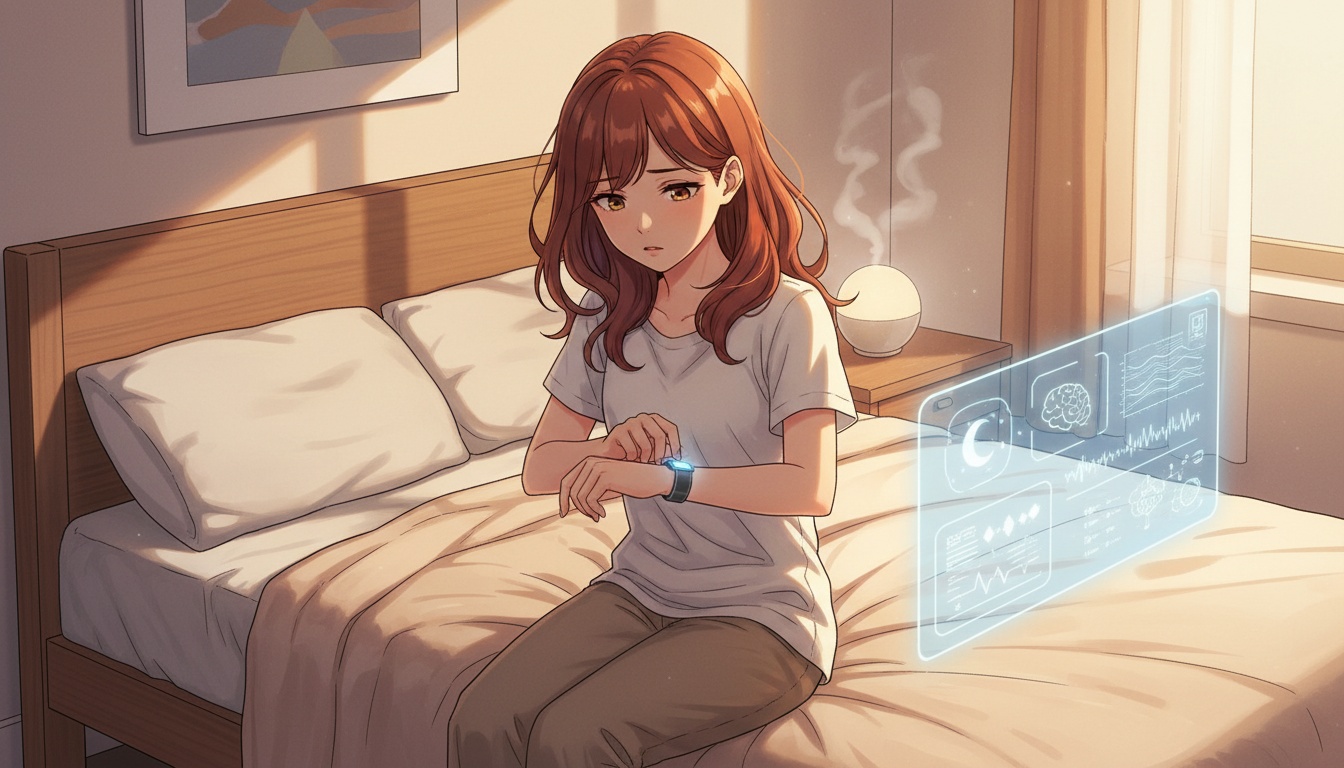
You checked your sleep score this morning. It said 62 — “fair.” You slept seven hours, woke up once, and your deep sleep was 18 percent. You don’t feel tired, but the number says you should. So now you’re Googling “how to increase deep sleep” at 7am, already anxious about tonight. If this sounds familiar, you’re not alone. And the tracker on your wrist might be the reason your sleep keeps getting worse.
We’ve talked before about how cortisol steals your sleep — the feedback loop where stress hormones spike at the wrong time and fragment your rest. This post is about a specific, modern trigger for that loop: the tool you bought to fix your sleep is keeping you in it.
What orthosomnia actually is
In 2017, researchers at the Rush University Medical Center published a case series in the Journal of Clinical Sleep Medicine describing patients who came in with self-diagnosed sleep disorders — based entirely on their wearable data. One patient, a 27-year-old woman, refused to believe her polysomnography results (the gold-standard lab test) showed normal sleep, because her tracker told her otherwise. She trusted the algorithm more than the medical data (Baron et al., J Clin Sleep Med, 2017).
The researchers coined the term “orthosomnia” — from “ortho” (correct) and “somnia” (sleep) — to describe the perfectionist pursuit of ideal sleep metrics. It mirrors orthorexia, the obsessive fixation on eating “correctly.” The parallel is exact: the tool designed to improve health becomes the source of anxiety that degrades it.
A 2024 cross-sectional study in Brain Sciences tried to measure how widespread this is. Among roughly 500 participants, 36 percent regularly used sleep trackers. Using a multi-criteria screening that combined tracker use, insomnia symptoms, anxiety levels, and preoccupation with sleep data, the researchers found orthosomnia isn’t a fringe phenomenon — it shows up in a meaningful percentage of users, especially those with pre-existing anxiety about sleep (Jahrami et al., Brain Sci, 2024).
Why your brain turns sleep data into sleep anxiety
The problem isn’t the tracker itself. It’s what your brain does with the information.
Sleep researchers describe something called the hyperarousal model of insomnia. The core idea: insomnia isn’t just a nighttime problem. It’s a 24-hour state of elevated physiological activation. Your nervous system stays slightly “on” — monitoring, checking, evaluating — even when you’re lying still in the dark.
A 2022 systematic review and meta-analysis in Sleep Medicine Reviews examined 20 studies comparing cortisol levels in people with chronic insomnia versus good sleepers. The result: people with chronic insomnia have moderately but consistently elevated cortisol, particularly in the evening and nighttime when it should be dropping (Dressle et al., Sleep Med Rev, 2022). Their stress systems are running hotter, all the time.
Here’s where the tracker enters the loop. You see a low score. Your brain registers it as a problem — something is wrong with your sleep. That registration triggers a low-grade stress response. Not dramatic anxiety, just a subtle activation. Your HPA axis — the system that controls cortisol — shifts from “rest” to “monitor.” That night, you go to bed with a slightly elevated cortisol baseline. You fall asleep a little later. Your sleep is a little lighter. The tracker records this. The score drops further.
A 2024 study in the Journal of Psychiatric Research confirmed this dynamic directly: hyperarousal doesn’t just accompany insomnia — it amplifies overnight, creating a self-reinforcing cycle where the state of being “alert to sleep problems” literally makes sleep problems worse (Rösler et al., J Psychiatr Res, 2024).
Why health-conscious people are most vulnerable
If you’re the kind of person who bought a sleep tracker in the first place, you’re probably disciplined. You research. You optimize. You solve problems by measuring them and adjusting. That approach works for nutrition. It works for fitness. It actively backfires with sleep.
Sleep is the one biological process that resists conscious effort. The Glasgow Sleep Effort Scale — a validated clinical tool — specifically measures how hard someone is trying to sleep, because that effort itself is one of the strongest predictors of insomnia severity (Doos Ali Vand et al., Nat Sci Sleep, 2020). The more deliberately you pursue perfect sleep, the further it moves away.
Every data point your tracker gives you is another opportunity for your brain to ask: Did I do something wrong? Deep sleep was low — should I take more magnesium? REM was short — did I eat too late? Sleep latency was 22 minutes — is my room too warm? Each question is a micro-stressor. Multiply that by every morning for months, and you’ve built a cortisol feedback loop that didn’t exist before you started tracking.
What to do instead
Stop checking your sleep score daily. This is the single highest-leverage change. If you can’t delete the app entirely, check once a week. The daily number isn’t giving you actionable information — it’s giving your anxiety a target. A study on CBT-I (Cognitive Behavioral Therapy for Insomnia) found that dysfunctional beliefs about sleep — including the belief that you need to monitor and control it — mediate outcomes on psychological distress, fatigue, and insomnia severity (Faaland et al., Sleep Med, 2023). Removing the daily data removes the belief trigger.
Audit your sleep routine for anxiety triggers. If your bedtime routine has more than four or five components, some of them are creating more stress than they’re relieving. Strip it down. Keep what clearly helps. Drop what you added from worry. The routine should feel calming, not like a pre-flight checklist.
Practice paradoxical intention. This is a CBT-I technique where you lie in bed and try to stay awake. It sounds counterintuitive, but it works because it removes the performance pressure. You can’t fail at falling asleep if you’re not trying to fall asleep. Clinical trials consistently show this reduces sleep latency and nighttime anxiety.
Give yourself a cortisol curfew. Anything sleep-related — research, supplement reviews, tracker checking, protocol adjusting — stops by 8pm. Your evening should be boring in the most radical sense. Your brain needs the signal that sleep is not a problem to solve tonight.
The supplement question
Two supplements have evidence for supporting the cortisol-sleep connection without adding to the optimization anxiety:
Magnesium Glycinate — supports GABA activity and cortisol regulation. The glycinate form is well-absorbed and doesn’t cause the digestive issues that oxide does. Take 200–400mg in the evening.
L-Theanine 200mg — promotes calm focus without sedation. Helps lower cortisol without adding another “sleep protocol” to worry about. Can be taken during the day for general stress or 30 minutes before bed.
The key: these are supports, not solutions. If you add them and then track whether they “worked” the next morning, you’ve just extended the loop. Take them. Don’t measure the result. If you’re curious about other natural approaches, see CBD vs. THC for sleep — but the same rule applies: try it, don’t track it.
What we still don’t know
Consumer sleep trackers measure movement and heart rate, then use algorithms to estimate sleep stages. Polysomnography — the clinical standard — measures brain waves, eye movement, and muscle activity directly. The gap between what your tracker reports and what’s actually happening in your brain is still significant, and no one has definitively established what level of tracker accuracy would be needed before the data becomes reliably actionable for healthy adults. Until then, the most honest thing your tracker can tell you is that it doesn’t know your sleep as well as you think it does.
Save for later — send to someone who checks their Oura score before they check how they actually feel.